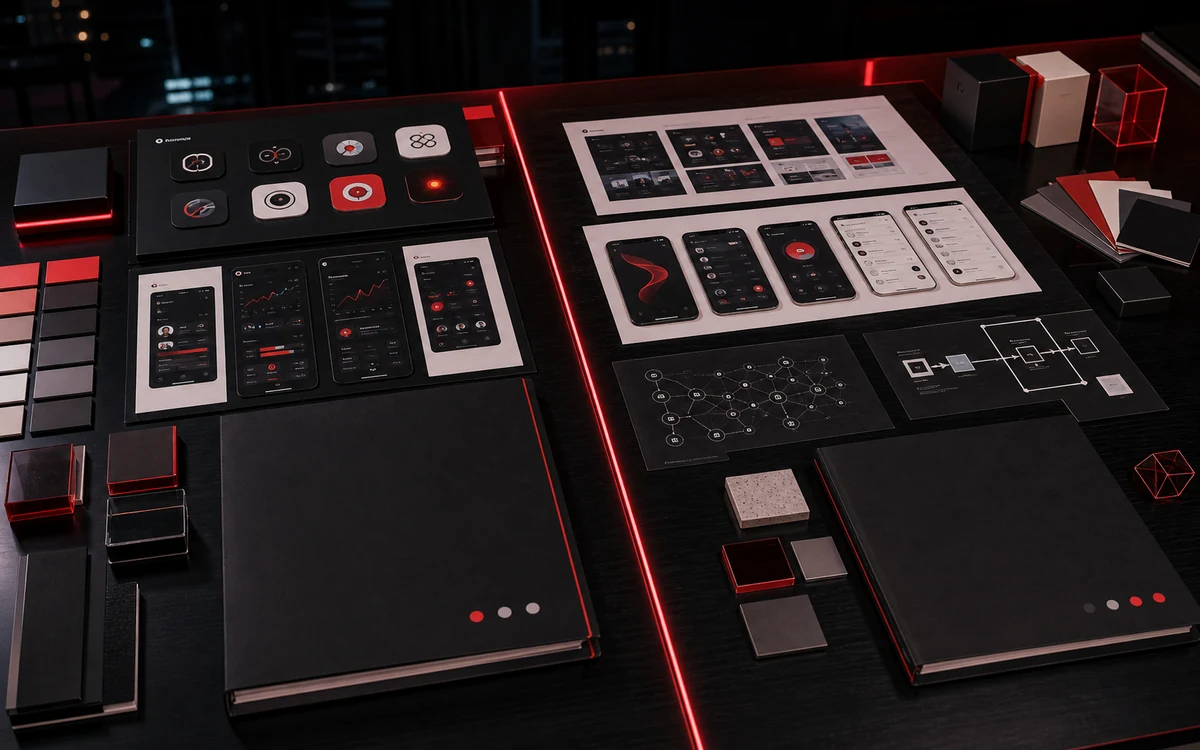
Short version: Ramotion is a San Francisco UI/UX and brand-identity agency working with Mozilla, Bitpanda, Salesforce and Discovery. Makreate operates in a similar quality tier but at a meaningfully lower price floor (USD 160/day vs Ramotion's typical $50K-$300K project tier) and a faster start (5-7 working days vs 4-8 weeks). The decision usually comes down to budget, location, and whether you need brand strategy at scale or focused UX execution.
This guide compares both on the dimensions that actually matter when you're picking a partner — pricing, engagement model, deliverables, and the decision criteria for "which one fits my situation."
At-a-glance comparison
| Dimension | Makreate | Ramotion |
|---|---|---|
| Founded | 2018 | 2009 |
| HQ | Remote-first (US / UK / UAE) | San Francisco, CA |
| Team size | ~20 senior practitioners | ~60 designers and engineers |
| Engagement floor (USD) | $160/day or $1,600/month | $30,000+ |
| Typical engagement (USD) | $20K-$200K project / $1.6K-$10K monthly | $50K-$300K over 2-6 months |
| Time to start | 5-7 working days | 4-8 weeks |
| Best for | Growth-stage SaaS, fintech, healthtech | Series A-C SaaS, fintech, brand-led tech |
| Engagement type | Retainer or fixed-price project | Project-based |
| Hours coverage | EST/PST/GMT-friendly | PST |
| Ships production code/design | Yes (UI + dev) | UI/UX + brand (sometimes front-end) |
Pricing comparison
The biggest practical difference between Makreate and Ramotion is the price floor. Makreate's UX Design pricing starts at USD 160/day or USD 1,600/month for retainers. A typical project — say, a SaaS dashboard redesign with research, wireframes, prototypes and a design system — runs $20K-$80K end to end.
Ramotion doesn't publish exhaustive pricing but most engagements start at $30K-$50K for focused UI work and run $100K-$300K for brand + product engagements. They charge premium SF-tier rates.
What you get for Makreate's price
- One senior designer (8+ years) leading the project
- Backed by a team of UX veterans (35+ combined years), available as needed
- Direct Slack channel — your engineer/PM talks to your designer, no account-manager layer
- Shipped work: wireframes, prototypes, UI, design systems, sometimes the build itself
- USD-fixed proposal in 48 hours, kickoff within a week
What you get for Ramotion's price
- Brand identity systems
- UI/UX design and prototypes
- Marketing-site design and build
- Mobile app design
- Design systems
- Logo and visual identity
- Sometimes: front-end engineering
- Brand guidelines
Engagement model
Makreate runs three engagement models:
- Daily retainer (USD 160/day): a senior designer dedicated to your team. You pay only for days they work. Good for ongoing UX needs without committing to a full-month retainer.
- Monthly retainer (USD 1,600/month): 40 hours/week of senior UX work. Best when you have continuous UX needs and want predictable monthly cost.
- Fixed-price project: defined scope, defined timeline, USD-fixed cost. Best when the project is well-defined upfront.
Ramotion runs multi-phase engagements. Engagements are typically scoped end-to-end across multiple workstreams (strategy, design, sometimes engineering) running 3-18 months. You commit to the full arc, not piece by piece.
Who they serve
Makreate's client list skews US, UK and UAE growth-stage: SaaS founders (pre-seed through Series C), fintech and tax-tech operators (Cleartax, Accuvat), healthtech and fitness (BurnCal AI), B2B enterprise (DESC, GGCF, ICICI Bank, IDFC First Bank, Oracle), and ecommerce (Sneakers retail, Glass World UAE). See the case studies.
Ramotion's client list: Mozilla, Bitpanda, Salesforce, Discovery, Eventbrite, Lobste.rs, Workato.
Deliverables
Makreate ships production-ready design work:
- UX audit reports + heuristic evaluations
- User research reports (qualitative + quantitative)
- Information architecture and user flow maps
- Wireframes (low and high fidelity)
- Clickable Figma prototypes
- Production-ready UI (Figma → handoff)
- Component libraries and design systems
- Often: the front-end build itself (HTML/CSS/React)
Ramotion ships:
- Brand identity systems
- UI/UX design and prototypes
- Marketing-site design and build
- Mobile app design
- Design systems
- Logo and visual identity
- Sometimes: front-end engineering
- Brand guidelines
When Makreate is the better choice
- You need senior UX work shipped in 4-12 weeks
- Your budget is under $250K for the engagement
- You're a SaaS, fintech, healthtech, ecommerce or B2B growth-stage company
- You want to skip the account-manager layer and talk directly to designers
- You need production-ready design, not just strategy
- You bill in USD or GBP and want pricing in your currency
Want to scope a project with Makreate?
30-minute discovery call, USD-fixed proposal within 48 hours, kickoff within a week.
When Ramotion is the better choice
- You need brand-identity + product-UX together in one engagement
- Your budget is $50K-$300K and you want a polished SF-tier finish
- You're a Series A-C SaaS, fintech, or brand-led tech company
- You can wait 4-8 weeks for kickoff
- You're US-based and want a PST-time-zone partner
For everyone else — most US, UK and growth-stage companies — Makreate is the closer fit. The two firms are solving different problems. Comparing them by price alone misses that point.
Frequently asked questions
Is Makreate cheaper than Ramotion?
Yes — Ramotion engagements start at $30K-$50K. Makreate UX Design starts at USD 160/day or USD 1,600/month with typical project work $20K-$200K. For lean engagements, Makreate's entry point is meaningfully lower.
Do both agencies do brand identity?
Yes. Ramotion is known for combined brand + product work. Makreate offers brand design as a separate service — see our Branding page — and frequently combines brand with UX, web or marketing services in a single engagement.
Which is better for a mobile app?
Both ship mobile-app UX work. Makreate's mobile work includes case studies for fintech, healthtech and consumer apps. Ramotion has strong mobile portfolio pieces. For most apps under $150K, Makreate is the closer fit on budget and speed.
How does the design system handoff work in each?
Both deliver Figma-native design systems with documentation. Makreate handovers include a quick walkthrough call and a written component-by-component handover doc. Ramotion's handover is similar.
Can Makreate ship a Ramotion-level finish on a smaller budget?
On focused UX/UI work — yes. The difference shows up when the scope is a full multi-month brand + product + marketing-site overhaul. For that scope, Ramotion's staffed model can do more in parallel.