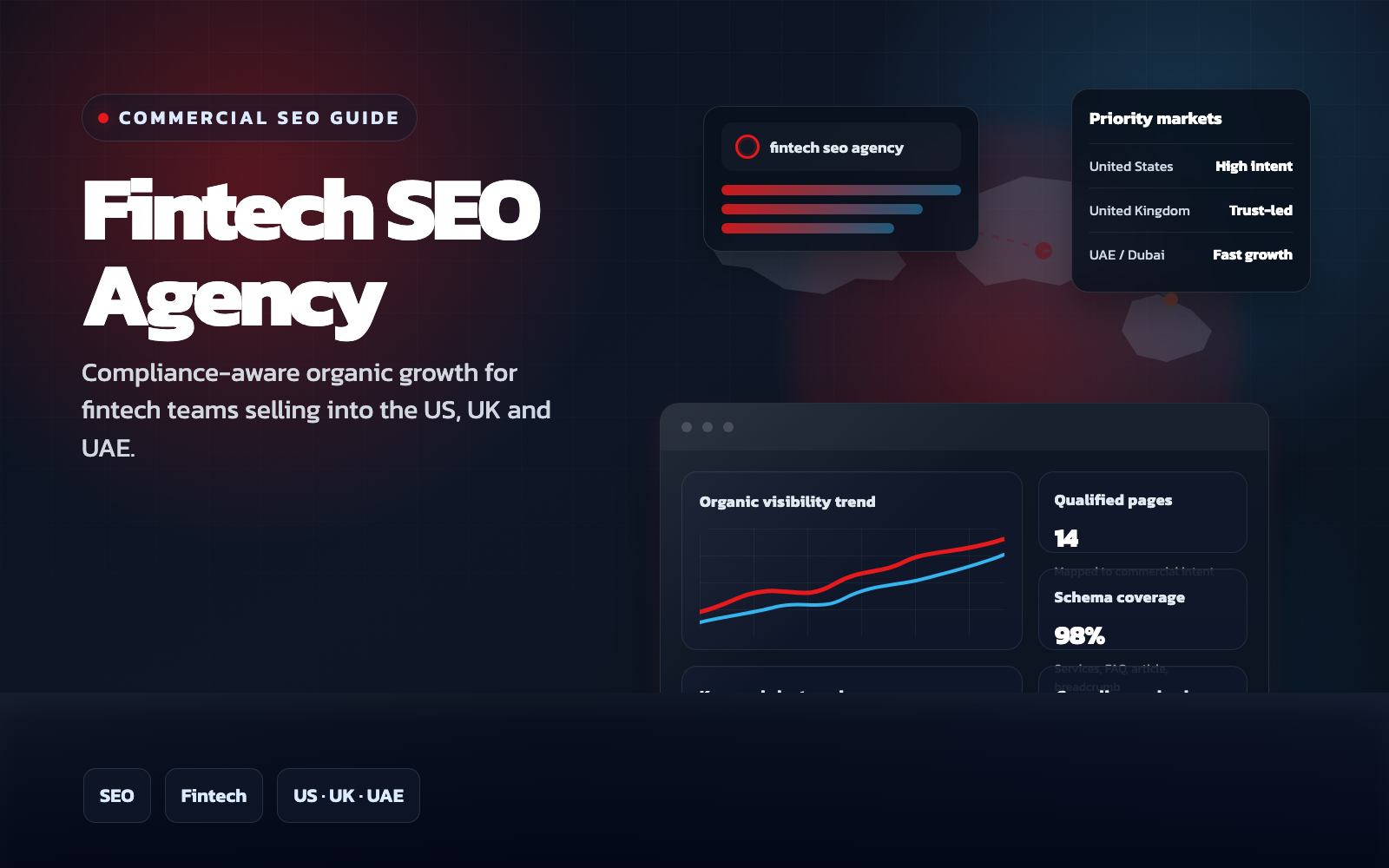
Most fintech companies do not need more blog content. They need a tighter commercial search strategy: better category pages, clearer product messaging, stronger trust architecture, cleaner internal linking, and landing pages matched to the way buyers actually search.
That distinction matters because fintech SEO sits in a harder category than generic B2B SaaS. Buyers are more skeptical, search queries are often more nuanced, and the copy has to do two jobs at once: explain the product clearly and avoid making unsupported claims. A good fintech SEO agency should understand both sides of that equation.
This guide is written for founders, growth leads and product marketers evaluating whether SEO deserves more budget in fintech, and what they should expect from an agency if they do invest. It is also useful if you already have traffic but the traffic is not turning into demos, signups or qualified conversations.
1. What fintech SEO actually needs to solve
Fintech SEO is not just about ranking for broad terms like "payment platform" or "wealth management software." It is about mapping search demand to specific buying contexts: card issuing, KYC tooling, embedded finance, lending infrastructure, treasury workflows, tax-tech, payroll fintech, expense management, cross-border payments, or consumer-facing finance products.
That means the agency's job is partly strategic. Before publishing content, it should help you answer a few questions clearly. Which buyer categories are commercially relevant? Which product terms are mature enough to target? Which searches indicate research intent versus buying intent? Which pages should convert directly, and which should nurture trust before a sales conversation?
If those answers are vague, SEO turns into content production theatre. Pages get published, traffic may even rise, but the qualified-pipeline number does not move. In fintech, that gap is especially expensive because the buying cycle is often long and the average customer value is high enough that low-intent traffic becomes distracting rather than useful.
2. When hiring a fintech SEO agency makes sense
Fintech companies usually get the most from SEO when three conditions are already true. First, the product category is understandable enough to name cleanly. Second, the website has a real conversion path, whether that is a demo request, onboarding flow, consultation, or qualified lead form. Third, the business is ready to invest in a 6-9 month compounding channel rather than looking for instant demand generation.
That means early-stage fintech teams can absolutely benefit from SEO, but only if they are past the "we are still figuring out what to call ourselves" phase. If your messaging is still unstable, paid acquisition and founder-led outbound often give clearer feedback first. Once the category language firms up, SEO becomes much more powerful because you can build pages against durable intent rather than temporary experimentation.
For later-stage teams, the agency becomes useful when the in-house team is too stretched to own the execution surface. Product marketing may know the ICP but not the technical SEO details. Engineering may understand the codebase but not commercial page strategy. Growth may know paid channels better than search architecture. The agency should close those gaps rather than add another reporting layer.
3. The commercial pages that usually matter most
A fintech SEO program that converts usually starts with pages close to revenue, not with educational thought leadership. In practice, that often includes category pages, solution pages by use case, comparison pages, regulated-market pages, and geo-aware commercial pages.
For example, a payments company may need a core category page, but it may also need supporting pages for merchant onboarding, subscription billing, card issuing, cross-border settlement, fraud tooling and API infrastructure. A lending product may need pages for embedded lending, SME financing, underwriting workflows, and partner-specific use cases. A B2B wealth platform may need separate pages for advisors, RIAs, white-label solutions and reporting workflows.
Those pages should not read like templated SEO copy. They should help a serious buyer orient quickly: who this is for, what problem it solves, where it fits in the stack, what implementation looks like, what trust signals exist, and what the next step is. A fintech SEO agency should be able to work with your product team to make those pages commercially persuasive, not just keyword-rich.
At Makreate, this is where SEO usually starts overlapping with website design and development and UX design. Search visibility without a credible landing-page experience leaves money on the table.
4. Why compliance-aware content matters in fintech
Fintech content has a narrower lane than many other SaaS categories. You often cannot imply certainty where the product has caveats. You cannot overpromise financial outcomes. In some categories, you also need clearer disclosures around availability, approvals, risk, security or data handling. That does not mean the copy has to become lifeless. It means the content needs discipline.
A serious fintech SEO agency should know how to write pages that are persuasive without sliding into unsupported claims. The usual pattern is to emphasize workflow clarity, product scope, implementation detail, trust architecture and audience fit. That is safer and often more effective than headline-level hype anyway, because fintech buyers are generally evaluating risk while they evaluate value.
That same discipline should carry into top-of-funnel content. Thought-leadership pages can work in fintech, but they should support the category pages rather than substitute for them. Good informational content helps buyers understand a category, compare approaches, or clarify a problem. Thin opinion pieces and generic trend summaries usually do not build durable commercial value.
In fintech, trust is not a layer you add after ranking. It is part of what makes the page worth ranking in the first place.
5. Technical SEO is not optional in this category
Fintech websites tend to accumulate complexity quickly. There may be multiple product areas, login states, documentation, developer pages, subdomains, gated assets, international pages and legal content. That makes technical SEO more than a hygiene item.
The agency should be looking at crawl behavior, canonical discipline, internal-link structure, indexation quality, structured data, page speed, duplication issues, JavaScript rendering risk, and whether the information architecture supports how buyers actually move through the site. If your docs or product pages are important to acquisition, they should not be an afterthought in the crawl graph.
Structured data is also useful here, especially for clarifying page types and improving how search engines interpret your site. FAQ, breadcrumb and article schema are easy wins. Depending on the site structure, product-adjacent schema and organization signals can also help. None of this replaces good content, but in fintech the clearer you make the site, the better chance you have of earning trust from both users and search systems.
6. US, UK and UAE fintech SEO should not be one generic page
One reason fintech SEO underperforms is that teams collapse very different markets into one global page. The search behavior, buyer expectations and trust cues in the US are not identical to those in the UK or UAE. Even where the same product is sold, the framing often needs to change.
US buyers often respond well to specificity around workflows, integrations, implementation clarity and category depth. UK pages may need stronger language around compliance context, financial operations and procurement confidence. UAE and Dubai pages often benefit from clearer geo relevance, implementation support and local-business credibility, especially when selling services, financial operations tooling or growth services into the region.
This does not always mean three completely different sites. It often means a cleaner structure with geo-aware landing pages, supporting content, and localized proof points where appropriate. For teams targeting fintech across these regions, we usually recommend pairing SEO work with pages tailored to the market, backed by a broader fintech industry positioning layer.
7. SEO should connect to conversion, not just traffic
If you separate SEO from CRO and demand capture, fintech performance usually flattens. The page ranks, the traffic comes in, but the site does not convert because the CTA is weak, the flow is unclear, the trust signals are too thin, or the user lands on a page that feels informational when they were actually ready for a commercial next step.
This is why good fintech SEO work often overlaps with advertising, landing-page design, analytics and CRM setup. Organic search should feed a measurable system. You should know which pages bring in demo requests, qualified leads or assisted conversions. You should know where users are dropping off. And you should be able to make page-level decisions based on that data.
For some fintech teams, SEO is strongest as the durable middle layer: paid search captures immediate demand, SEO compounds category authority and commercial visibility over time, and outbound helps create demand where search volume is still limited. The right agency should be able to place SEO properly within that wider acquisition mix.
8. How to evaluate a fintech SEO agency
Ask better questions than "how many articles will you write?" Ask how they map buyer intent. Ask what the first 90 days would change on your site. Ask how they handle legal or compliance review. Ask how they decide between category pages, solution pages and educational content. Ask how they measure success beyond sessions and impressions.
You should also look for signs that the agency understands adjacent disciplines. Fintech SEO frequently requires page design decisions, tighter copy, schema implementation, internal-link logic, and a cleaner page hierarchy. If the agency only knows content production, you will likely end up needing multiple vendors to finish the work properly.
Makreate tends to fit teams that need that overlap. We work across SEO, website development, branding, UX and growth execution, which matters when the bottleneck is not just ranking, but turning search intent into a credible buying journey.
Need a fintech SEO plan that connects to revenue?
Makreate works with fintech, SaaS and growth-stage teams across the US, UK and UAE on SEO, websites, UX and paid acquisition. We can map the first 90 days around your commercial pages, not vanity content output.
Frequently asked questions
What should a fintech SEO agency prioritize first?
Usually commercial page structure, indexation quality, internal linking and conversion paths. Informational content comes after the revenue-adjacent architecture is clear.
Can a fintech startup outsource all of SEO to an agency?
You can outsource most execution, but the best outcomes still require input from the founder, product marketing and sometimes legal or compliance. The agency should reduce effort, not remove collaboration.
Do fintech companies need separate pages for each market?
Often yes, especially for the US, UK and UAE. Search language and trust expectations differ enough that geo-aware commercial pages usually perform better than one generic global page.
Should fintech SEO focus on blogs or landing pages?
Landing pages first. Blogs can support authority and internal linking, but they should not come at the expense of category, solution and conversion-oriented pages.
How do you measure whether fintech SEO is working?
Track more than rankings. Look at qualified organic leads, demo requests, assisted conversions, page-level engagement on key commercial pages, and whether search is creating a larger pool of intent you can capture efficiently.



Comments
No comments yet. Be the first!